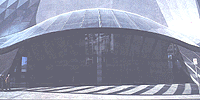
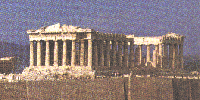
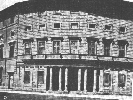
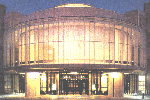
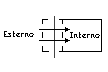
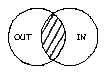
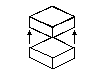
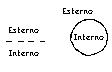
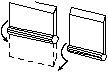
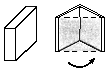
  In the collective imagination there has always been day and night, light and darkness, which are two aspects of reality, two sides of the same medallion. Every day we experience these things, but this very "habit", this way of living through these experiences always in the same way brings about a greater and greater loss. Often we "never" notice them, but every time we cross an interface we change a little. Architectural examples show us that it is possible to invert this path and that it can only be done through different experiences: this is the third side of the medallion. "It is the tendency of material to transcend space, to reconcile itself with fluid, while the same waters are organised and subdivided en masse." 20 Therefore, experiencing the boundary which invades the external or internal, or which uses instruments such as covering which wraps around like in the Riverside Centre of Seidler, Brisbane, even though we do not cross anything in a physical manner. "The science of matter has as a model the origami (the art of folding paper) and the folding of matter must be compared firstly with light, the chiaroscuro, the way in which the folding catches the light and varies according to time and illumination." 21 The case of the classical passage from light to dark is to be found in the Parthenon, the Palazzo alle Colonne in Rome, and especially in columns with flutings where light and dark coexist.
|