
Technical Part of Final Report
(2 October 2002 – 2 January 2005)
Contract reference N. ASI/B7-301/98/679-10 (Asia-Link Programme)
Project Title: Euro-China Exchange: Technology and Culture of Generative
Design Approach
Name of Beneficiary: Politecnico di Milano, Coordinator Prof. Celestino
Soddu
Period covered by this Interim Report: 2 October 2002 – 2 January 2005.
Due date of this Interim Report:
2 July 2005
Executive Summary
The Asia-link program “Euro-China exchange, Technology and Culture of
Generative Design Approach was started the 2nd of October 2002 and
was implemented, following the accepted schedule, until the 2nd of
January 2005. Activities were decelerated in the spring of 2003 when, because
of Sars emergence, all the meetings between European and Chinese people were
interrupted also for the strong will of involved European Universities that had
forbidden holding meeting with Chinese together with European Students inside
the Universities.
This caused the stop of the most of program activities until the summer
2003. The establishment of the remote activities, with videoconferences and
Internet forums, was not enough to realize the requested results. In particular
we needed to postpone the meetings in China planned for May related to
establish applied projects and case studies for workshops and the summer
courses in Europe planned for July.
Starting with September 2003, with the end of this sanitary emergence,
all the activities were strongly implemented. Because of that reason, the length
of the program was extended until January 2005 (3 months more) and all
activities were implemented for reaching the planned aims.
Workshops in China, Summer (and Winter) courses in Europe, seminars in
China and Europe, conferences and thesis supervisions were implemented
following the new accepted schedule and action plan. Interesting feedbacks in
more important Chinese magazines in the field of architecture and design were a
really interesting (overcoming the expectations) result of these activities.
This, together with demonstrations of interest in European magazines (annexed
“Il Congresso”, a diplomatic/politic magazine of Italian delegation in European
Parliament), and the interest of other Chinese universities (like Tsinghua and
BCLU in Beijing, Hunan University, Xi’an University and Shanghai University) to
participate to the activities of the program, gave us the opportunity to
consider the program as a success. The applied projects, activity n. 6,
involving European and Chinese partners were the most difficult activities to
manage but, starting from the second year of the program, some common projects
was implemented.
The program started up the
October 2nd 2002 with the preparation of the meeting of December and the
participation of all the partners to the international conference
"Generative Art 2002" organized by the coordinator of the project
Prof. Celestino Soddu.
First activity has been the
presentation of our Asia-Link program to the meeting among the persons
responsible of the Italy-China exchange activities, among which the coordinator
of the program Celestino Soddu, with the rector of the Polytechnic in Milan,
with Jun Han, Scientific Adviser of the embassy of the Chinese Popular Republic
in Italy, with Mario Zanone Poma, President of the Chamber of Commerce
Italian-Chinese and with Mr. Rosso, delegated of the foreign office of Italy,
where the opportunities of implementation of the program are been
identified.
Subsequently
(October-November 2002) the region Lombardia has proposed its participation to
the program, through its formative activities office, supporting the
amplification of the laboratory of generative design.
In November 2002 the
coordinator, Prof. Celestino Soddu was invited as guest speaker to the Asia
Cities Summit in Singapore and he, with the manager of the project Enrica
Colabella, presented some proposals and the running Asia-link program as
important reality of mutual cooperation in the field of urban quality.
All the partners have
participated in the meeting of December 10th 2002 in Milan for starting up the
activities. The treated items have been:
1. Finality and structure of
the program and definition of the schedule of the activities and of their times
of activation and implementation.
2. Activation of the Laboratories
of Generative Design in the centers of Kassel, Eindhoven, Shanghai and Tianjin.
Laboratories have been activated in the following months, according to the
program.
3. Times and ways of
realization of the first session of seminars in Europe that has been programmed
for July 2003 to Eindhoven, Kassel and Milan following the program of the
activity 3 and the results of the previous meetings. (Seminars were postponed
to November/December 2003 because of Sars emergence, following the request of
involved European universities)
4. Times and modes of
realization of the workshops in China, programmed for September 2003 following
the program of the activity 4 (the workshop was implemented the 15-28 September
2003)
5. Times and modes of the
creation of the website of the program that will be active within April 2003.
(The website was realized and it is actually working http://www.generativedesign.com/asialink/asialink.htm)
6. Convocation of the next
operational meeting, to activate the operational projects foreseen by the
activity 6. The meetings for
implementing the activity 6 were held three times each year for all the
duration of the program.
Starting from December 2002,
all the partner’s delegations have participated to the international Generative
Art conferences. The first in December 2002 and then in December 2003 and
December 2004, contributing with papers and speeches in the round tables. The
contributions of the Asia-link partners were published in the conference
proceedings (the electronic version is in the website www.generativeart.com and the paper
versions were published each year by the GDLab of Milan Polytechnic
University).
The 12 December 2002 the
program Asia-Link was introduced to the participants to the Generative Art
Conference and the themes and their operational potentialities have been
discussed with a panel of international people expert in the program’s involved
fields
The subsequent months,
following the SARS emergence, all activities that needed direct contact were
suspended but, using videoconferences, the preparation of common researches,
common supervisions to master and PhD thesis and all concerning running activities
was implemented.
In September 2003 the planned
workshops in China were implemented with a one-week-workshop in Shanghai
followed by one-week-workshop in Tianjin.
On November/December 2003 was
held, in Milan, the “winter” course. It was the activity that, cause SARS, was
not possible to hold in July 2003. The participation of all delegations and the
structure of subsequent workshops: the 1st managed by Kassel GDLab
and the 2nd by Milan GDLab with an “internal competition of mixed
groups of master students from Europe and China, saw a success and the results
(annexed) were really interesting.
On December 2003 the running
activities of Asia-link program were presented as operative structure and as
researches in progress to the GA2003 participants.
2004 was a full year of
activities. In April was established a seminar “Identity&Design” in China
and it was held in Beijing in the Italian Embassy, together with an exhibition
of architectural design works concerning Chinese and European cities. The seminar
was followed by a workshop about generative approach in Town identity and in
Industrial production identity and quality. The participation involved not only
the partners but also some European guests and other Chinese universities like
Tsinghua and BLCU of Beijing, Shanghai University, Xi’an University and Hunan
University. The proceedings, with papers concerning the common activities of
the program, were published (annexed).
In July 2004 a second moment
of meeting all together, involving guests and European-Chinese postgraduate
students, was the summer course held in Rome with the seminar “De Identitate” and the subsequent workshop
hosted in the spaces of the University of Rome La Sapienza.
In October 2004 a series of
lectures and short workshops was held in Shanghai and Beijing together with
meetings for implementing activity 6 and with the participation to the design
week in Wuxi. The results were the acceleration of this activity focusing
opportunities and constrains. This activity was supported by the previous
report made by the management of the program (annexed)
On December 2004 the
partner’s delegation meet in Milan to valuate the results of research
activities, Master and PhD thesis involved in the program and all other
activities made in the last two years.
On 15 December 2004 the final
results of the Asia-link program were successful presented to a panel of
participants to GA2004 international conference for final valuation of the
activities.
The program ended the 2nd
January 2005. Subsequent meetings between European partners focused this
evaluation and concurred to prepare the final report.
According to the original project proposal, the activities were implemented:
Activity 1: Generative Design Labs.
GDLabs were established and
fully worked with different projects and identified participants. Their
activity is going ahead going over the end of the program.
Activity 2: Thesis supervision. The exchange supervision among all the partners
was established. It was realized with meetings and with remote interchanges.
Further collaborations are established between European and Chinese
universities and this activity is going ahead also after the program ended. The
results of these theses were presented in the last GA international
conferences.
Activity 3: Summer courses in Europe. The planned courses were two. Following the
accepted schedule, the 1st Summer Course (July 2003) was postponed
cause Sars to 29 November 2003 (it was a Winter Course). The second Summer
Course was held in July 2004.
Activity 4: Workshops in China and Europe. The program planned two workshops in
China. The 1st workshop was held the 15 September in Shanghai and 22 September in Tianjin. In the
same period meetings activity with Tsinghua University in Beijing were
implemented too with the support of Tianjin staff. A second workshop was held
in April 2004 in Beijing for involving all Chinese (Shanghai and Tianjin)
partners together. It was extended to
Changsha (Hunan university) and Xi’an University that supported the related
expenses. A 3rd workshop in China was implemented in October 2004 in
Shanghai at Tongji and Shanghai Universities, followed by a meeting in Beijing
and in Wuxi.
Activity 5: Joint Research programs for PhD and Master. The scheduled activities
were implemented and some research programs, established between Milan-Tianjin,
Eindhoven-Shanghai, Kassel-Shanghai involving professors and young researchers,
are going ahead through the end of the program
Also if not directly planned in the program, a Master (PhD level) course
was designed by Milan and Kassel GDLab in Macau for all Chinese postgraduates
about the generative approach to Town Identity management. It is not yet
operative but its preparation is going ahead together with Macau University and
it will start in September 2005.
Activity 6: Applied projects in China. Proposals were made by Shanghai and Tianjin
for applied projects of Architecture and Town planning. The meetings in
Shanghai and Tianjin identified some projects. The first one, a project for a
new town in the north of China, was discussed together with government
officers. Other projects, like the new Austro-Ungarian district and Italian
district bin Tianjin, were planned, discussed but not yet implemented.
Architectural projects in Shanghai, Tianjin and Beijing was made by the GDLabs
of Tongji and Milan and presented in seminars and exhibitions. The last one,
the new tower in Tianjin, was a project realized by Milan and Tianjin partners
together and presented to the local administration officers.
Activity 7: The International Conferences Generative Art GA2002, GA2003 and
GA2004, made by the Milan Generative Design Lab in December 2002, 2003 and 2004
was the occasion to communicate to an international audience the activities of
the Asia-link program and the common researches of its partners. The programs
and the proceedings of these conferences (annexed) show a strong participation,
with interesting printed papers, of all the partners and of other people from
Asian Universities.
Activity 8: the Website of Asia-link program was established and upgraded. http://www.generativedesign.com/asialink/asialink.htm. Exhibitions on Generative Design were
realized in China (Beijing and Hong Kong) and in Europe (Milan). The participation, November 2002, of the
coordinator of the program, Prof. Celestino Soddu, to the Asian City
Summit in Singapore as invited speaker, was important to communicate the aims
and the interest of this Asia-link program. The proceedings of Generative Art
Conference, with the contribution of all the partners, were published in 2002,
2003 and 2004. The seminar in Beijing (Identity and Design) produced
interesting papers and has implemented the common researches and the (annexed)
published proceedings of the Summer seminar in Rome (De identitate) has
confirmed the work in progress established by the Asia-link program. Some
articles in European magazines and in important Chinese newspapers and
magazines (Design magazine and Architecture magazine) were published (annexed)
and some other will be published following the interest of this program that is
going ahead after the end of Asia-link support.
I.
Introduction
Ø
The overall internal
conditions for the general project’s implementation were good and all
partners participated to the activities with professors directly involved in
the program and with post-graduates and doctorate students that participated to
seminars, workshops and worked for their thesis with shared supervisions by European
and Chinese professors. The Chinese partners appreciated the results and other
Chinese universities asked to be involved to the program.
Ø
The external conditions
were signed by the SARS problem in the period of February-July 2003. In this
period the activities was implemented by remote meetings using videoconferences
and by Internet. This partial interruption of activities is the reason for
enlarging the project schedule from 24 months to 27 months sliding the end from
2 October 2004 to 2 January 2005.
Ø
Achievements (referring to
overall objectives of the program):
Aligned with the overall objective of the Asia-Link
Program, this project promoted multilateral networking of architecture and
design education staff and advanced relationships among Politecnico di Milano
University in Italy, University of Kassel in Germany, Eindhoven University of
Technology in The Netherlands, Tongji University and Tianjin University in
China, enlarged successful to other Chinese Universities like Tsinghua and
BLCU, Shanghai University, Xi’an University and Hunan University. The project
developed Europe-China co-operation, first of all among the participating
universities to fostering and promoting mutual awareness and understanding
especially in the area of technology and methodology of generative approaches
in creative building and cities design
The activities implementation has:
A.
Upgraded and enhanced the
skills and mobility of teaching, research staff and postgraduate students of
the participating universities, particularly in the field of architectural and
industrial design, through (1) collaborative meetings and design competitions,
(2) seminars in Europe and China, (3) workshops of special design project
focuses in China, and (4) creation of joint research groups with specific
themes among habitat identity and quality, industrial design and intelligent
production, teaching methodology for evolutionary architecture, housing and
industrial design;
B.
Promoted the exchange of
experiences and encourage mutual knowledge and recognition of study programs
and reciprocal exposure and access to higher education through the means listed
above. The results of this activity promoted the involvement of Chinese
postgraduates to European Universities (like Sun Chengyu, from Tongji University
that is now at Eindhoven University) and the involvement of European professors
in the teaching activity in China (like Celestino Soddu from Milan Polytechnic
University that is now Honorary professor of Xi’an University and Shanghai
University);
C.
Promoted networking between
European and Chinese design education communities by extending to these new
partners the existing network of Generative Design community, sustained by the
international GA conference held annually in Politecnico di Milano University for
the last 7 years;
D.
Enhanced the attractiveness
of European design education within its higher education system among Chinese
communities through the comprehensive cultural exchange and common experience
in this collaborative project; The generative approach to design has been
experimented by Chinese university partners and this experimentation has
strongly connected Chinese and European teaching approach to design. The common
interest, that will be presented in the papers in next GA conference, is the main
part of the references that changed the design teaching approach in the
involved partners;
E.
Experimented the mutual
opportunities in the design and construction sectors and created opportunities
of future extended co-operations for mutual economic benefits by introducing
the most advanced technologies of intelligent design and industrial production
in China. To fit these opportunities, the program has done an analysis of the
opportunities in Europe-China development of generative approach for industrial
production. This operative research and business plan will be presented
successfully in the 2003 GA conference and was used to enhance the activity 6
of this program;
The project achieved the following
multilaterally benefits:
1. The
dissemination, diffusion and expansion in China of the latest development of an
innovative approach to design and design education that has been developed to a
mature level of leading stage for European and western design culture
(generative design and its related tools, methods and applications);
2. The recognition
and application of the generative design teaching model, and the development of
a new operable and effective European-Chinese design education model based on
the same technology and methodology;
3. The
development, exchange, establishment and application of a new design
methodology and practices that comparatively fuses and integrates the European
formalization of design synthesis with Chinese dialectic analysis of design and
evolutionary design process;
4. The diffusion
and expansion of the technology and the philosophy of intelligent industrial
production in the fields of building and industrial design, where this approach
has as reference the European culture instead of US culture.
5.
Established the possibility of European-Chinese mutual opportunities for
human resources in the field of professional design activities, in construction
industry and emerging intelligent industrial production manufacturing industry.
Ø Achievements (particular issues):
1. Seminars, workshops, summer courses and the 3
international conferences gave the mutual opportunity to know how European and
Chinese universities operate in the field of creative and innovative education
systems. Exchanges will be done and now people from Chinese universities has
consolidated European references and people from European universities has
consolidate teaching and research activities in China;
2. The cultural approach to design processes and,
particularly the generative design processes, following the experiences and
cultural heritage of Europe, has been known by Chinese partners and has changed
the teaching approach in the involved Chinese universities and in other
universities of China;
3. The mutual opportunities to develop, with common
teams, projects in the building and construction sector, which today is growing
in China, were developed only partially. This because of problems linked to the
loss of rules concerning intellectual property and difficulties linked to the
organization of the process Design-Investment-Construction in China:
4. Real good exchange has been realized in the field of
design approaches for increasing quality and identity of local environments.
This topic is strongly connected with the European tradition and was the main
topic of two seminars, one in Beijing “Identity&Design” and the other in
Rome “De Identitate”. This field is now, in the main field of Architecture and
Town design, one of the most interesting topics for Chinese universities in
connecting with European Universities.
5. In the field of Intelligent Industrial production with
generative approach, that is a particular European advanced operative research,
the Chinese universities, particularly Tongji University (a partner) and Hunan
university (that asked to be involved) extended their activities and doctorate
thesis in this field. Articles regarding this topic and the Asia-link program
and interviews to the coordinator of this program in Chinese magazines confirm
this interest.
Ø
Constrains:
1. The main constrain was in developing common design
activities (as indicated in the point 3 of previous paragraph) because of the
loss of rules concerning intellectual property in China and because of the
structure of the process of building and town construction that limited the
possibility to develop common design projects. But, in any case, some projects
were made, also if only as proposals to the city government or inside common
participation to design competitions.
II.
Implementation
of Activities
The activity of each partner
was planned in the first two month of the program and developed, subsequently
to the 1st meeting in Milan in December 2002 following the
established program.
The Generative Design Labs
(GDLabs) were established in Kassel, Eindhoven, Shanghai (Tongji Univ) and
Tianjin and the activities started up in January 2003.
In April 2003, following the
need to re-schedule in fall/winter the meetings in China with the leader of the
program and the summer courses in Europe, planned for July 2003, we fixed the
planned September 2003 workshops in China and rescheduled the seminars from
July to November 2003, before the scheduled participation to the Generative Art
International Conference, GA2003. In the meantime the coordinator asked to the
EC to enlarge the duration of the project from 24 to 27 months with the same
cost.
The second year of activities
was implemented following the schedule and upgrading each event for fitting the
planned results. In particular,
A.
Following the suggestions of
the meeting with the monitoring team, we worked to implement the activity 6,
that was not enough implemented in the 1st year. In particular the
Chinese partners have found out some interesting applied projects in the field
of architecture and town design. These projects will be implemented jointing
the Generative Design Labs teams, European and Chinese together. We have
identified and approved some study cases in Town design, architecture and
Industrial design and we used them in the Workshop made in April 2004 in
Beijing, in the summer course in July 2004 and in meetings and workshops in
September and November 2004.
B.
The Generative Design Lab of
Politecnico di Milano implemented the development of a structured study for the
promotion and management of operative projects based on generative design
approach. The study programme cover from a business plan related to generative
design opportunities in China until the using of the study results. This
implemented study was useful to pursue the aims of the program.
C.
Developing academic mutual
exchange in research and thesis supervision:
-
We identified and developed
some fields of research together with the European and Chinese GDLabs.
-
We identified and discussed
the researches running in the involved GDLabs and the presentation to
international conferences. The participation of all the Labs involved in the
Asia-link projects will be really good and the international participants to
the conferences appreciated the work done together with European and Chinese
involved universities.
D.
Workshops in China and in
Europe and summer/winter courses were implemented as scheduled.
1.
Meetings, lectures and
workshops in Shanghai, Tongji University, and in Tianjin University (14
September – 2 October 2003 and in Shanghai in October 2004)
2.
Meetings, lectures in Xi’an,
Changsha (Hunan University) and Beijing (March-April 2004)
3.
Workshop and seminar in
Beijing (April 2004)
4.
Summer course in Rome (July
2004)
5.
A sequence of meetings with
Government and University people in Shanghai, Tianjin and Beijing for
establishing applied projects regarding the restoring of old buildings using
generative advanced approaches, new architectures, the rebuilding of historical
quarters and the project of new towns. (September 2003 in Tianjin and Shanghai,
April 2004 in Xi’an, Changsha, Shanghai and Beijing, June 2004 in Shengzhen,
October 2004 in Shanghai and Wuxi, November 2004 in Shanghai and Beijing)
E.
Meetings with other Chinese
Universities (Tsinghua University September 2003, Xi’an University, Hunan
University and Shanghai University April 2004, October and November 2004) to
enlarge and establish new research activities jointing European and Chinese
partners.
F.
The 5th, 6th and 7th
Generative Art Conference GA2002, GA2003 and GA2004. We made and sent the call
for papers and all GDLabs worked to prepare and present their papers.
G.
We implemented the videoconferencing activity and Internet forums
to enhance suggestions and discussion among partners, especially during the
SARS emergency.
H.
The website http://www.generativedesign.com/asialink/asialink.htm
was implemented and upgraded.
I.
Meeting with all partners was
done in China and in Europe. Dates were December 2002, September 2003, December
2003, April 2004, October 2004 and December 2004. During SARS emergency (spring
2003) we used videoconferencing.
J.
This activity was
self-sustainable because it will be supported by Macau administration. The
Milan and Kassel GDLabs made a sequence of meetings in Macau with local
Government, University of Macau, Arcasia architects association and IEEM that
established the starting up of a PHD level Master (Master IDEAS) on the topics
of Generative Approach, opened to post graduated people of China and other
Asian countries. The starting time is to fall 2005. The topic is the Generative
Approach in the management of Town Identity.
Description of each planned Activity
Ø Activity 1, Generative Design Labs.
The 5 Generative Design Labs, GDLabs of Milan, Eindhoven, Kassel,
Shanghai and Tianjin were established soon after the starting of the program. Their
activity was planned in the first meeting in Milan December 2002 and they
worked together during the all time of the program. Each of them has
established its website and the activity of each GDLabs was presented in all
the seminars (Beijing 2004 and Rome 2004) and in all the international
conferences (GA2002, GA2003 and GA2004) with papers and posters. Their activity
is going ahead after the end of the program.
1.
GDLab
Milan. This Lab, directed by the
coordinator of the program, planned the most of the scheduled activities.
Particularly the 3 international conferences GA2002, GA2003 and GA2004, the
seminar “Identity&Design” in Beijing, the “winter” course in Milan, the
summer course in Rome, the European workshops in Milan, with lectures in
Changsha, Xi’an, Shanghai, Beijing and meetings in Wuxi and Shengsen and some
other events like the exhibitions about Generative Design in Rome, Beijing,
Hong Kong, Los Angeles, Washington DC. The involved staff was: Celestino Soddu,
Quinsan Ciao, Enrica Colabella, Giovanni Luca Soddu, Marco Longatti, Li Zhang,
Alessandro Balducci, GFG Partners, Aleadesign srl, Gangemi Ed, Daniele Gugelmo,
Viviana Basilico and the master students.
2.
GDLab
Kassel. This Lab, directed by Hans
Dehlinger, had a relevant position in research common activities in the field
of industrial design linking its research with the staff of Tongji univ. and
planning and implementing the activity in China, particularly the workshops
(activity 4) and the activities 5 and 6.
This GDLab presented their research reports and papers in all the
activities done by the program. The involved staff was: Hans Dehlinger, Marcus
Shein, Oliver Endemann, Ole Werner and other postgraduate students.
3.
GDLab
Eindhoven. This Lab, directed by Bouke
de Vries, had a strong work concerning generative approach in Architectural
design particularly in activities 2 and 5 concerning master thesis and common
research. The involved master students, like Sun Chengyu from Tongji Univ, has
established academic relationship with this Lab continuing after the end of the
program. This GDLab presented their
research reports and papers in most activities done by the program. The
involved staff was: Bouke de Vries, Aant van der Zee, Daan Willems and other postgraduate
students.
4.
GDLab
Tongji Shanghai. This Lab,
directed by Wang BoWei, associate-director Zhong Tang, had a relevant activity
in Thesis supervision (Activity 2) and research programs for PhD and Master
students (Activity 5) in the field of architecture and industrial design,
presenting these activities in all the seminars and workshops implemented by
the program. More, this Lab organized the Shanghai workshops and meetings for
discussing thesis and research activities. The involved staff is: Wang Bowei, Xiang Wang, Hong Wu, Le-Yan
Zhang, Meng Wang, Ji-wei Lu, Yi-Jie Zhang, Ming Dai, Cheng-yu Sun, Yong-yi Lu,
Xing-Yu Yang, Zhen-yu Li, Xi Xu, Zhao-Xi Liu, Yi Chen ,Kai-fend Wang,
Xiao-Sheng Huang, Yao-dong Zhang, Jing-Wen Gu, Jie Wu, Zhong Tang.
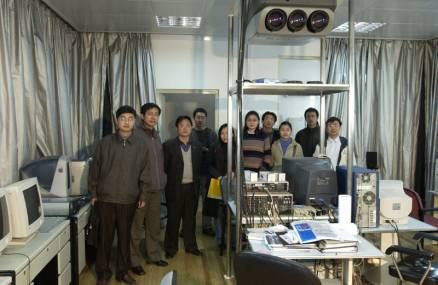
In the image the GDLab of Tongji University in Shanghai.
5.
GDLab
Tianjin. This Lab, directed by Yang
Changming had a relevant activity in one of the more difficult field, the
applied projects in China (activity 6) realizing with the Milan Lab some common
teams for applied projects in Tianjin (the Austro-Ungarian district, the new
city near Tianjin and a new tower in the city). The activity of this lab was
also applied to the other fields, like research programs, thesis supervision
and organization of the workshop in Tianjin University. The common design
activity between this Lab and the Lab in Milan is going ahead over the end of
the program. The involved staff was: Chang-Ming Yang, Hua Zhang, Fan-Wei Zhang,
Jie Cai, Jun Ren, Xi-Xin Chen, Lin Tian, Jing Bai, Li-Jun Zheng, Jin-Song Zhao,
Li Yan, Xiao-Bing Wang.
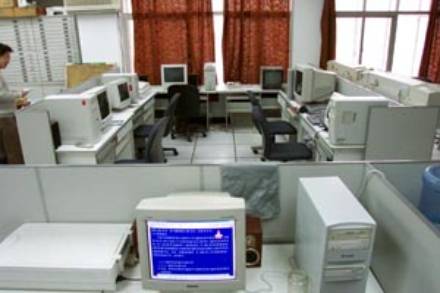
In the image the GDLab of Tianjin University.
Ø Activity 2, Thesis supervision.
The involved thesis were:
1. European:
PhD thesis of Marcus Shein and master thesis of Ole Werner guided by Prof. Hans
Dehlinger in the field of industrial generative design, Master thesis of Daan
Willems under the guide of Prof. Bauke de Vries in the field of Architectural
Design Management Systems, doctorate Li Zhang and master students Michael
Zamblera, Cesare Balossi, Davide
Ghisleni, Federica Guerra, Gianluca Pesenti under the supervision of Prof.
Celestino Soddu and Prof. Enrica Colabella in the field of Architectural
Generative Design.
2. Chinese: Master
candidates Xiang Wang, Hong Wu, Le-Yan Zhang, worked on the inherited
generation mechanisms of university campuses and similar type of architectural
complexes led by Professor Bo-Wei Wang; Master candidate Meng Wang, guided by
the advisor Professor Ji-wei Lu, made a thesis on the inherited generation
mechanisms of urban public spaces; Ph.D. candidates Yi-Jie Zhang and Ming Dai
joint by Master candidate Cheng-yu Sun, under the guidance of Professor Yong-yi
Lu, identified the inherited generation mechanisms in Chinese historical
architecture preservation; Master candidate Xing-Yu Yang, guided by the advisor
Associate Professor Zhen-yu Li, worked on the inherited generation mechanisms
of various urban housing; Master candidate Xi Xu and Zhao-Xi Liu, guided by
their advisors Associate Professor Yi Chen and Lecturer Kai-fend Wang on
generation mechanisms of Chinese traditional and ancient furniture design;
Ph.D. candidate Xiao-Sheng Huang and Master candidate Yao-dong Zhang, guided by
their advisors Professor Jing-Wen Gu and Lecturer Jie Wu, on computer
implementation of shape and body representation governed by various generation
mechanisms; Xi-Xin Chen, Ph.D. candidate, Jing Bai, Ph.D. candidate, Li-Jun
Zheng, Ph.D. candidate, Jin-Song Zhao, Ph.D. candidate, Li Yan, Ph.D.
candidate, Xiao-Bing Wang, Master candidate, on architecture and Lin Tian,
Ph.D. candidate, on Ancient Architecture Preservation, under the supervision of
Prof. Chang-Ming Yang, Prof. Hua Zhang, Prof. Fan-Wei Zhang and Prof. Jie Cai.
3. Title of thesis with official shared supervisors:
-
Li Yan, Ph.D. candidate,
“Generative Design and Grids” (Tianjin, Milan, Kassel)
-
Rong Lin, Master candidate,
“Generative design and Codes of Roofs and Doors”, (Tianjin, Milan, Kassel)
-
XinXin Chen, Ph.D. candidate,
“Generative Approach in architecture restoring”, (Tianjin, Milan)
-
Zhang Yijie, Ph.D. candidate,
“Generative design of Chinese Pagodas”, (Tongji, Milan)
-
Sun Chengui, Master candidate,
“Higher or Denser?”, (Tongji, Eindhoven)
- Dai Ming, Ph.D. candidate, “Urban Generative design”, (Tongji, Milan)
-
Liu Zhao Xi, Xu Xi,
“Forniture generative design”, (Tongji, Milan, Kassel)
Ø Activity 3 Summer (winter) courses and workshops in
Europe
1.
Winter
course in Milan (December 2003) realized
together with a design competition for the participation of common
European-Chinese teams that worked together. (Annexed results)
This workshop was improved with the competition “Idea as Code” that was
created and implemented during the workshop in Milan in December 2003 by the
manager of the program Enrica Colabella.
We defined research teams with together European and Chinese
postgraduates and doctorate students. The results-posters of these
collaboration and of the common research approach are also in the website. The
results-posters of these joint researches were also presented to the Generative
Art Exhibition in the exhibition hall of Politecnico di Milano University
during the GA2003 International Conference (annexed results). Using this
experience, we defined the international competition “Idea as Code” opened to
international students. The call for proposals was launched in the website www.generativeart.com with the
deadline of the end of August 2004 and as price, for European and Chinese
participants, was the participation to GA2004 conference and exhibition in
Italy. The winner was a German student but the first 5 students, 3 European and
3 Asian, were invited to present their work and they came to GA2004
conference/exhibition.
Hans Dehlinger, GDLab of Kassel University, managed a further workshop
in the “winter course” in Milan. The results of the Workshop "from
arbitrary starting point via generator to result" are annexed.
Participants to the winter course in Milan 2003:
|
|
first name |
Celestino |
|
last name |
Soddu |
|
|
occupation |
Professor |
|
|
e-mail |
celestino.soddu@polimi.it |
|
|
msn |
N/A |
|
|
university |
Polytecnic / Milano |

|
|
first name |
Enrica |
|
last name |
Colabella |
|
|
occupation |
Professor |
|
|
e-mail |
enrica.colabella@polimi.it |
|
|
msn |
N/A |
|
|
university |
Polytecnic / Milano |

|
|
first name |
Michael |
|
last name |
Zamblera |
|
|
occupation |
Master Student |
|
|
e-mail |
somavica@libero.it |
|
|
msn |
N/A |
|
|
university |
Polytecnic / Milano |

|
|
first name |
Cesare |
|
last name |
Balossi |
|
|
occupation |
Master Student |
|
|
e-mail |
cesare.bergamo@libero.it |
|
|
msn |
N/A |
|
|
university |
Polytecnic / Milano |

|
|
first name |
Davide |
|
last name |
Ghisleni |
|
|
occupation |
Master Student |
|
|
e-mail |
ghizlo@libero.it |
|
|
msn |
N/A |
|
|
university |
Polytecnic / Milano |

|
|
first name |
Chiara |
|
last name |
Gimagalli |
|
|
occupation |
Master Student |
|
|
e-mail |
arsenico.c@virgilio.it |
|
|
msn |
N/A |
|
|
university |
Polytecnic / Milano |

|
|
first name |
Federica |
|
last name |
Guerra |
|
|
occupation |
Master Student |
|
|
e-mail |
peterpan_bg@hotmail.com |
|
|
msn |
N/A |
|
|
university |
Polytecnic / Milano |

|
|
first name |
Gianluca |
|
last name |
Pesenti |
|
|
occupation |
Master Student |
|
|
e-mail |
jean80@inwind.it |
|
|
msn |
N/A |
|
|
university |
Polytecnic / Milano |

|
|
first name |
Marco |
|
last name |
Longatti |
|
|
occupation |
Architect |
|
|
e-mail |
m_arc@arkham.it |
|
|
msn |
N/A |
|
|
university |
Polytecnic / Milano |

|
|
first name |
Li |
|
last name |
Zhang |
|
|
occupation |
Designer |
|
|
e-mail |
||
|
msn |
||
|
university |
Shougang Central Designing
Institute |

|
|
first name |
Hans |
|
last name |
Dehlinger |
|
|
occupation |
Professor |
|
|
e-mail |
||
|
msn |
N/A |
|
|
university |
Kassel |

|
|
first name |
Ole |
|
last name |
Werner |
|
|
occupation |
Master Graduate (dipl.des) |
|
|
e-mail |
ole_Werner@web.de |
|
|
msn |
N/A |
|
|
university |
Kassel |

|
|
first name |
Olivier |
|
last name |
Endemann |
|
|
occupation |
Master Graduate (dipl.des) |
|
|
e-mail |
oe@genestics.de |
|
|
msn |
N/A |
|
|
university |
Kassel |

|
|
first name |
Daan |
|
last name |
Willems |
|
|
occupation |
Student (Master) |
|
|
e-mail |
||
|
msn |
d3vlin@hotmail.com |
|
|
university |
TU/e / Eindhoven |

|
|
first name |
Kun |
|
last name |
Zhang |
|
|
occupation |
doctor |
|
|
e-mail |
doctorkun@hotmail.com |
|
|
msn |
doctorkun@hotmail.com |
|
|
university |
Tong ji / Shanghai |

|
|
first name |
Zhong |
|
last name |
Tang |
|
|
occupation |
Senior Engineer |
|
|
e-mail |
||
|
msn |
tangzzzk@hotmail.com |
|
|
university |
Tong ji / Shanghai |

|
|
first name |
Chaotsi |
|
last name |
Leu |
|
|
occupation |
Student (Master) |
|
|
e-mail |
liuzhaoxiiii@sohu.com |
|
|
msn |
Liuzhaoxi2003@hotmail.com |
|
|
university |
Tong ji / Shanghai |

|
|
first name |
Sun |
|
last name |
Chengyu |
|
|
occupation |
Student(Master) |
|
|
e-mail |
apolloc@online.sh.cn |
|
|
msn |
ibund@163.com |
|
|
university |
Tong ji / Shanghai |

|
|
first name |
Wang |
|
last name |
Xiang |
|
|
occupation |
Student (Master) |
|
|
e-mail |
||
|
msn |
wang_xiang1979@hotmail.com |
|
|
university |
Tong ji / Shanghai |
|
|
first name |
Leyan |
|
last name |
Zhang |
|
|
occupation |
Student(master) |
|
|
e-mail |
zhangleyan66@163.com |
|
|
msn |
zhangleyan1979@hotmail.com |
|
|
university |
Tong ji / Shanghai |

|
|
first name |
Qi |
|
last name |
Zhao |
|
|
occupation |
Master Student |
|
|
e-mail |
||
|
msn |
emilyzhao@sh163.net |
|
|
university |
Tong ji / Shanghai |

|
|
first name |
Yisui |
|
last name |
Wang |
|
|
occupation |
Student (Master) |
|
|
e-mail |
wangyisui@163.net |
|
|
msn |
wangyisui@hotmail.com |
|
|
university |
Tong ji / Shanghai |

|
|
first name |
Chang ming |
|
last name |
Yang |
|
|
occupation |
Professor |
|
|
e-mail |
||
|
msn |
N/A |
|
|
university |
Tianjin / Tianjin |

|
|
first name |
Wei |
|
last name |
Zhang |
|
|
occupation |
Phd. / Associate Professor |
|
|
e-mail |
zhangwei@tju.edu.cn |
|
|
msn |
tju_zhangwei@hotmail.com |
|
|
university |
Tianjin / Tianjin |
|
|
first name |
Li |
|
last name |
Yan |
|
|
occupation |
Phd. / Doctorate |
|
|
e-mail |
||
|
msn |
N/A |
|
|
university |
Tianjin / Tianjin |

|
|
first name |
Xinxin |
|
last name |
Chen |
|
|
occupation |
Phd. Student |
|
|
e-mail |
chaoschen@hotmail.com |
|
|
msn |
chaoschen@hotmail.com |
|
|
university |
Tianjin / Tianjin |

|
|
first name |
Rong |
|
last name |
Lin |
|
|
occupation |
Student (Master) |
|
|
e-mail |
Linrong3585@sina.com.cn |
|
|
msn |
N/A |
|
|
university |
Tianjin / Tianjin |

2.
Summer
course in Rome (23 July – 2 August 2004) realized with the seminar “De Identitate” and the subsequent common workshop.
(Annexed proceedings).
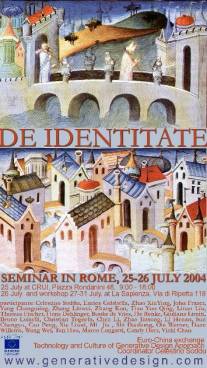 Poster of the seminar
Participants to seminar and subsequent workshop:
Prof. Celestino Soddu Politecnico Milano Univ.
Prof. Enrica Colabella Politecnico Milano Univ.
Prof. Zhao Xy BLCU, Beijing University
Prof. John Frazer Prof. and Researcher, Belfast
Prof. Yang Changming Tianjin University
Prof. Zhang Linwei Tongji University
Prof. Zhang Kun Tongji University
Prof. Tian Yun Qing Shanghai University
Prof. Linan Liu Xi'an University
Prof. Thomas Fischer Kassel University
Prof. Hans Dehlinger Kassel University
Prof. Bauke de Vries Eindhoven University
Prof. He Renke Hunan University
Mr.Christian Tognela Politecnico Milano Univ.
Mr.Chen Li Tianjin University
Mr.Zhao Jinsong Tianjin University
Mr. Xu Zongwu Tianjin University
Miss. Li Henan Tianjin University
Miss. Liang Hanglin Tianjin University
Mr. Sun Chengyu Tongji University
Mr.Cao Peng Tongji University
Mr.Xie Liwei Tongji University
Miss Mi Jia Tongji University
Mr.Shi Daohong Tongji University
Mr. Ole Werner Kassel University
Mr. Daan Willems Eindhoven University
Mr.Wang Wei Hunan University
Mr.Tan Hao Hunan University
Mr.Marco Longatti Politecnico Milano Univ.
Mrs Candy Herr Kassel University
Mrs Vicki Chan Designer, Shanghai
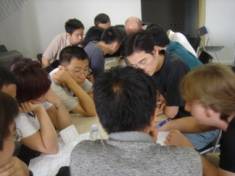
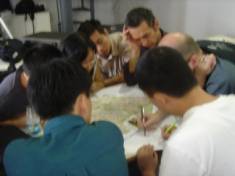
Workshop in Rome, following the seminar.
Program
of seminar: DE IDENTITATE, Rome, 26-27 July 2004
|
Monday
26 July 2004, 9:00 AM
|
|
Opening, Celestino Soddu,
coordinator of Asia-link program “Euro-China exchange, technology and Culture
of Generative Design approach. |
|
Digital
code scripts for generative and evolutionary design: De Identitate John Hamilton Frazer Autotectonica, UK |
|
Identity of Generated
Objects – Gain and Loss Along Transformational Chains. H. Dehlinger O. Werner GDLab
Kassel, Department of Product Design, Kunsthochschule Kassel, Kassel,
Deutschland. |
Humanistic origins of Creative Architecture
Giuliana Limiti
Universita’ di Roma III, Italy
|
|
Dutch
Dwellings B. de Vries, A. van der Zee Faculty of Architecture,
Building and Planning, GDLab Eindhoven, Eindhoven
University of Technology, The Netherlands. |
|
Visionary
Variations of Milano. Generative Projects Designing the Identity of Milano. Celestino Soddu GDLab Milan, Politecnico di
Milano University, Italy |
|
Identity
beyond Vision: Discover the Cultural Genes of Yuelu Academy HE Renke,YUAN Xiang School of Design, Hunan
University, Changsha, China
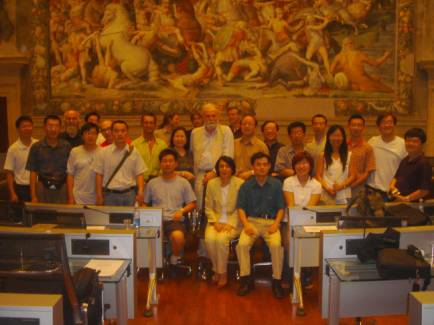
Some participants to the
seminar “De Identitate” in Rome 2004. The space used was given by CRUI, the
Italian Universities Rectors Conference. |
Monday
26 July 2004, 14:00 AM
|
|
Shanghai
Keeps its Identity in the City Renewal Tian YunQing, MArch Department of Art &
Design, Shanghai University |
|
Identity, a double
vision in a generative process Enrica Colabella GDLab Milan, Generative Design Lab, Department of
Architecture and Planning Politecnico di Milano
University, Italy |
|
The
Identities of Watertown Shaoxing Zhang Linwei GDLab Tongji, Tongji
University, Shanghai, China |
|
Italian
Identity and Chinese Identity Zhao XiuYing, BLCU Beijing |
|
The
Extreme Generative Approach and the Acquisition of Identity Zhao.Jinsong School of Architecture Tianjin University, Tanjin. Yang.Changming GDLab Tianjin, The Academy
of Architectural Design and City Planning of Tianjin University, Tianjin |
|
Historic
Urban Morphology and Continuous Influence on Nowaday City Linan Liu Xi’an Universiuty of
Architecture and Technology |
|
Tuesday 27 July 2004,
9:00AM |
|
Identity
Crisis and High-Speed Urbanism. Form and Morphogenetic Process as Generators
of Design Identity Thomas Fisher, Kassel University and Hong Kong Polytechnic University Christiane M. Herr, Kassel University and The University of Hong Kong |
|
Generative
Design – Programmed Identity Hans Dehlinger Ulf C. Cadenbach, Henrik Hornung, Tobias O. Schelkes GDLab Kassel, School of
Art, University of Kassel, Germany |
|
Image
of JNSX and Generative Design Cao Peng GDLab Tongji University, Shanghai,
China |
|
Space-time
Idea Contained In the Mysterious Figure Of Primitive Era Zhang Yu-kun, Li He-nan, Li zheng School of Architecture,
Tianjin University, China |
|
Don’t
Lose the History Again. The Forming, Developing and Crisis of the Identity of
Tsingtao City Chen Li,, Yang Changming GDLab Tianjin, School of
Architecture, Tianjin University, Tianjin, China |
|
Spatial
Forms Generated From Shao Xing Culture Zhang Kun, Wang Bowei GDLab Tongji, College of
Architecture and Urban Planning, Tongji University, Shanghai |
|
Tuesday
27 July 2004, 14:00AM The
Becoming of Form. Morphogenesis as Paradigm to preserve Identity in Complex
Architecture Daan Willems Faculty of Architecture, Building and Planning, GDLab Eindhoven, Eindhoven
University of Technology, The Nederlands |
|
The
Identifiable Spacial Designs Bred by the Architect and Apollo SUN Chengyu GDLab Tongji, Architecture
Department, Tongji University, Shanghai, PR China |
|
Knowledge
Transformation in Conceptual Design: An Approach to Build a Model of CAID
Knowledge System TAN Hao , ZHAO Jianghong School of Design, Hunan
University, Changsha, China |
|
Meta-knowledge:
A Method to Encode and Decode Products’ DNA in Knowledge Lifecycle WANG Wie, ZHAO Jianghong, School of Design, Hunan
University, Changsha, China |
|
The
Study of Waterfront Modality of Shaoxing Mi Jia GDLab Tongji, Tongji
University, Shanghai, China |
|
The
design For Old areas of Shaoxing Xie Liwei GDLab Tongji, Tongji
University, Shanghai, China |
3.
Workshop
in Milan (December 2004) realized
before the GA conference to work about common research activities and master
thesis. The involved people are from Milan GDLab, Kassel GDLab and Tianjin
GDLab.
Ø Activity 4 Workshops in China
1. Workshop in Shanghai September 2003. The workshop was planned by Tongji University and its
dean Wang Bowei together with the manager of the program Quinsan Ciao that went
to Shanghai before the workshop. The workshop involved 4 people from Europe (2
from Milan and 2 from Kassel), 4 professors from Tongji and 21 postgraduate
students of Shanghai.
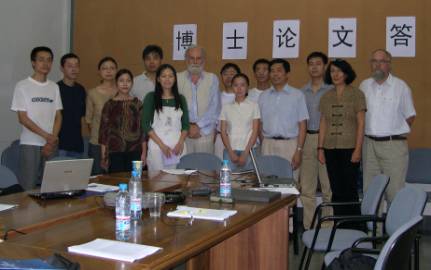
Image of people involved in the workshop in Tongji University in
September 2003.
2.
Workshop
in Tianjin September 2003. Tianjin
University and its dean Chang Ming Yang planned the workshop. The workshop
involved 4 people from Europe (2 from Milan and 2 from Kassel), 4 professors
from Tianjin and 24 postgraduate students of Tianjin. The Tianjin staff
involved people of Tsinghua University and all together we went to Tsinghua
University for extending workshop and holding a meeting and lecture.
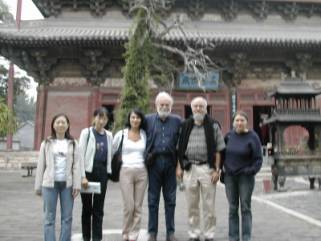
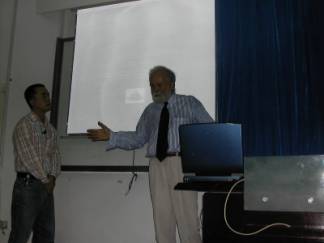
Visit to Tianjin monuments during the Tianjin workshop and a lecture of
the coordinator Prof. C. Soddu at Tianjin University’ Postgraduate students.
3. Workshop in Beijing April 2004, together with the seminar “Identity and Design”. The
Milan GDLab planned the seminar with its managers E. Colabella and Q. Ciao in
the Italian Embassy in Beijing. Chinese partners from Tongji University and
Tianjin University were involved in the preparation of the workshop – seminar
involving other universities (especially the deans of Xi’an, Hunan, BLCU, and
Shanghai Univ.) for planning an operative meeting about the program and its
benefits.
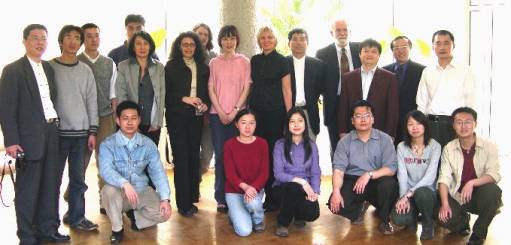
Participants:
Celestino Soddu, Coordinator Asia-link program, Politecnico di Milano
University
Enrica Colabella, Manager of Asia-link program, Politecnico di Milano
University
Quinsan Ciao, Manager of Asia-link program
Wang Bo Wei, Head of the Faculty of Architecture, Tongji
University,Shanghai
Yang Chang Ming, Head of the Faculty of Architecture, Tianjin University
Linan Liu, Vice Head of the Faculty of Architecture, Xi'an University
Sally Beardsley, Designer, Denmark
Karina Moraes Zarzar, Delft University of Technology, Holland
Luigi Gazzola, 1st Faculty of Architecture, Rome La Sapienza University
Gu Jun, China Architecture Design & Research Institute
Tang Zhong, Tongji University
Zhang Kun, Tongji University
Ole Werner, Kassel University
Zhao XiuYing, BLCU Beijing
Ji Tie, Design&Management Institute, Hunan University
Ming Xi Tang, Hong Kong Polytechnic University
He Renke dean, school of art and design, Hunan University
Tian Yuanqing Art department, shanghai university
Zhang Wei, Tianjin University
Zhang Yukung, Tianjin University
Yan Li, Tianjin University
Chen Li, Tianjin University
Song Yuhui, Tianjin University
Lin Rong, Tianjin University
Li Shu, Tianjin University
Liang Hanglin, Tianjin University
Yisui Wang, Tongji University, Shanghai
Qi Zhao, Tongji University, Shanghai
Leyan Zhang, Tongji University, Shanghai
Wang Xiang, Tongji University, Shanghai
Sun Chengyu, Tongji University, Shanghai
Chaotsi Leu, Tongji
University, Shanghai
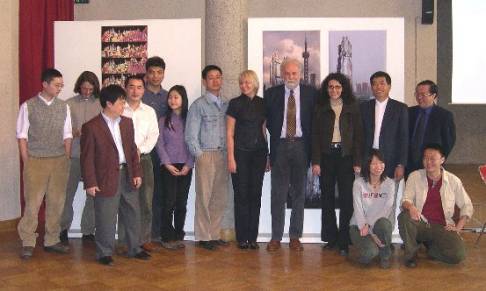
The study cases for these workshops were real applied occasion of Town
design, architecture and industrial design proposed by the partners:
1.
The design, with generative
approach, of the Austro-Ungarian consulate and related quarter in Tianjin.
2.
The generative design of
furniture using Ming Codes
3.
The
Reconstruction of Haihe Lou (a traditional Chinese style multi-storied building
near the Haihe River in Tianjin which was a famous scene and a temporary palace
of the emperors in the Qing Dynasty);
4.
The design of
restoration of Italian Quarter in Tianjin with the identification of Chinese /
Italian identity codes of this environment.
4.
Other
workshop/lectures/meetings in China in 2004. Over the first workshop in Beijing (April 2004) there have been other
workshops in China in 2004. Workshops were held in Shanghai University (23
April 2004 with 2 people from EU, two professors and 12 postgraduate students
and 21 October with 2 EU Professors, 3 professors and 14 postgraduate
students), in Xi’an University (April 2004 with 2 Prof. From Eu, 4 Prof. And 18
doctorates and PhD) and in Hunan University (21 April 2004 with 2 Prof. from
EU, the dean, 4 professors and 28 postgraduate students). We held two meetings
/ workshops in Tongji University (19 April with 2 from EU, the dean and 5
doctorate, Phd and the 21 October 2004 with 2 from EU, the dean, two professors
and 4 doctorate/postgraduates)
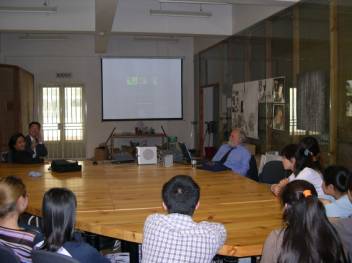
Workshop in Shanghai, extension to Shanghai University
Ø Activity 5 Research programs.
Identified common research activities in the topics:
-
Generative Design of Roofs
(Tongji, Tianjin, Kassel, Milan)
-
Generative Design: Ming
Paradigm of Design as a design starting point for the generation of
contemporary furniture and other contemporary design objects (Kassel, Tongji, Milan)
-
Generative new Town Design
(Tianjin, Milan)
-
Generative approach to
Historical Chinese places representation (Tianjin, Shanghai and Milan)
-
Cities Identity management
and design (Tianjin, Shanghai, Eindhoven and Milan)
-
The Ph.D. and Master level
graduate research program in generative design “The
Generative Mechanism of Chinese Nomads Architecture and Its Interpretation in
Cultural Anthropology” (Tianjin, Eindhoven, Milan).
-
Research and analyze typical patterns in Chinese
and European tradition. Based on the extraction and isolation of archetypes,
generative programs will be implemented as “pattern – generators”. The patterns
derived from Chinese sources will be restructured to fit the European market
and vice versa, the patterns of European origin will be restructured to fit the
Chinese market. (Kassel, Milan, Tianjin)
-
Analysis of typical elements of Chinese and
European “formal languages” as displayed by specific ranges of products (e.g.:
kitchen, bathroom). Identification of basic formal building blocks and
characteristics. Development of Generators (programs), which allow a mix of
elements. (Kassel, Milan, Tongji)
-
Identity codes and design approach. Shaoxing
city safeguard, recovery and renovation. (Tongji, Milan)
-
Identity codes and design approach. Tsingtao.
(Tianjin, Milan)
The results
of these research activities are explained in the subsequent documents,
organized in 3 groups:
1. Generative Design for Cities Identity, a research program proposed by the Milan GDLab
involved the Chinese partners with discussions and common proposals for Shanghai,
Beijing, Tianjin, Xi’an, Shaoxing,
Quingdao.
Related Papers was
presented at seminars and conferences of the program (annexed)
2. Generative Furniture Design, a research program proposed by Milan and Kassel
GDLabs involved Tongji GTLab with operative results presented in international
conferences.
Related Papers was
presented at seminars and conferences of the program (annexed)
3.
Generative
Architectural Design, a research
program proposed by Milan and Eindhoven GDLabs involved Tianjin and Tongji
GDLabs with interesting research results presented in the international
conferences and in the seminars of the program.
Related Papers was presented at seminars and conferences of the program (annexed)
Ø Activity 6 Applied Projects in China
First meetings in Shanghai and in Tianjin were able to identify problems
and opportunities. In particular a first applied project was established: a new
town of 400.000 inhabitants near Tianjin, to be designed using the identity
codes of Chinese tradition together with Italian tradition. The delegation of
Tianjin University, Milan Polytechnic University and Kassel University visited
the identified site with the Government delegation and the first approach to
designing the town was established. This activity is self-sustainable because
is supported by the Chinese Government.
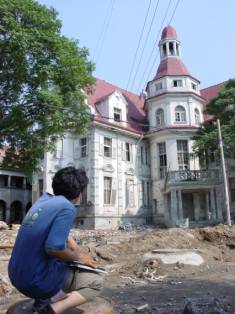
Operative workshop in Tianjin for the Austro-Hungarian district
renovation.
In Tianjin, more, a common design opportunity was identified in the
Austro-Ungarian district and discussed for defining a common proposal to the
government.
A common project was realized for a new tower in Tianjin and for the way
to support Tianjin Identity in its actual strong increasing complexity.
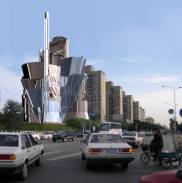
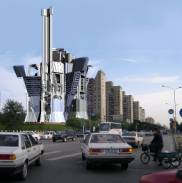
Two variations of the project for a cultural centre in Beijing
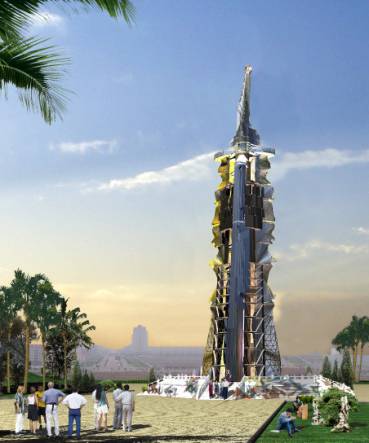
Tianjin Tower project (Milan and Tianjin GDLabs)
A project was identified with Government
Officer in Shanghai for an applied research on the Shanghai identity, working
with generative approach in a particular block of Shanghai city. The letter of interest is not yet received from
Shanghai Government but some design proposals were prepared and were discussed
in Shanghai and during the Beijing seminar “Identity&Design”. More, the
Tongji GDLab opened a discussion on the Architectural Design for The
International Expo 2010 to be held in Shanghai and proposed it for study case
of the workshop.
A project managed by Tongji University and that involved other Chinese
and European partners was the renovation of historical city of Shaoxing, which
had a common discussion and proposal during the workshop in Rome 2004 together
with other projects involving the Identity of the cities Tsingtao and Xi’an
In the field of Industrial Intelligent production, an operative research
“Approach for the realization of a business plan related to Generative Design
opportunities in China” was established to verify the real opportunities of
implementing this activity. This research was implemented for the GDLab of
Milan by GFG partners. The study program, with a business plan related to
generative design opportunities in China, was presented and discussed in the 6th
Generative Art conference in Milan in December 2003.Subsequent meetings were
done in Shanghai (April and October 2004), Changsha (April 2004), Wuxi (October
2004, participating to “Chinese design week” and meetings with Chinese
companies and professors), Shengsen (June 2004) for going ahead with industrial
production following the path identified by this document.
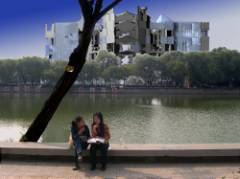
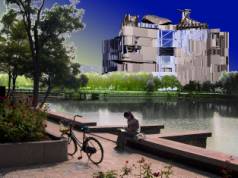
Two projects for the Tianjin University Campus
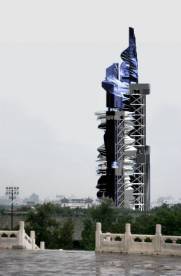
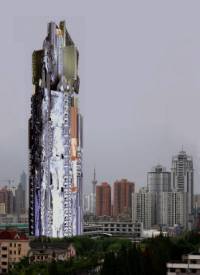
A-
New Pagoda
in Beijing
B-
Residence
Tower near Tongji university in Shanghai
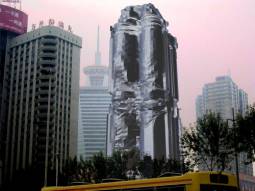
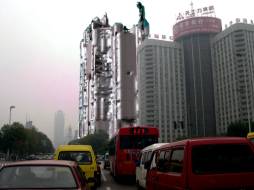
Two projects of new buildings in Tianjin downtown with the aim of
increasing Tianjin identity. An office building and a research department.
Ø Activity 7 Generative Art International Conference:
1. GA2002
Papers of Asia-link involved partners and of other Asian universities:
“La citta’ ideale”, Generative Codes Design Identity
Celestino Soddu
Director of Generative Design Lab, DiAP
Politecnico di Milano University, Italy
Instance and System: a Figure and its 218 Variations
H. E. Dehlinger
Director of Kassel generative design Lab
Kunsthochschule Kassel, University of Kassel, Germany
Generative and Evolutionary Techniques for Building Envelope Design
John Frazer, Tang Mingxi, Patrick Janssen
Design Technology Research Centre, School of Design, The Hong Kong
Polytechnic University, China SAR,
Julia Frazer
Architectural Association, School of Architecture, London
Liu Xiyu
DTRC and Shandong Normal University, PRC
Generative Design: Rule-Based Reasoning in Design Process
Quinsan Ciao
Generative Design Lab, DiAP
Politecnico di Milano University, Italy
Ball State Univ. US
Figura, Aura uniqueness
Enrica Colabella
Generative Design Lab, DiAP
Politecnico di Milano University, Italy
The generate method of Multi-storey Chinese Pagodas
Tang Zhong, Zhang Yijie
Tongji University, Shanghai, China
A generative design system based on evolutionary and mathematical
functions
Liu Xiyu
Design Technology Research Centre, School of Design, The Hong Kong
Polytechnic University
and
School of Information and Management, Shandong Normal University, P.R.
China
John Hamilton Frazer
Director of the Design Technology Research Centre, School of Design, The
Hong Kong Polytechnic University
Tang Ming Xi
Design Technology Research Centre, School of Design, The Hong Kong
Polytechnic University
Design from Known to New -Issues of Generative Architecture under
Digital Environment-
Shuenn.-Ren Liou
Department of Architecture, Tunghai University, Taichung, Taiwan.
Applied Generative Procedures in Furniture Design
Markus Schein
GDLab Kassel
Department of Product-Design, University of Kassel, Germany
Euro-China exchange: technology and culture of Generative Design
approach
Presentation of the Program financially supported by European Commission
Celestino Soddu
Coordinator of the program, Generative Design Lab, DiAP, Politecnico di
Milano
Quinsan Ciao
Co-coordinator, Generative Design Lab, DiAP, Politecnico di Milano
Enrica Colabella
Manager, Generative Design Lab, DiAP, Politecnico di Milano
Hans Dehlinger
Partner, Kassel University
Wang Bowei
Partner, Dean of Tongji University, Shanghai, China
Changming Yang
Partner, Dean of Tianjin University, China
Aant van der Zee
Eindhoven Technological University
Giancarlo Spinelli
Director of CRI, Politecnico di Milano University
Dora Longoni
CRI, Politecnico di Milano University
Computation-Universal Voxel Automata as Material for Generative Design
Education
Thomas Fischer
School of Design, The Hong Kong Polytechnic University
Generative Architectural Design and Complexity Theory
Christiane M. Herr
Department of Architecture, Hong Kong University.
Computer Aided Evolutionary Architectural design
Aant van de Zee, B. de Vries
Faculty of Building and Architecture, Design Systems Group, Eindhoven
University of Technology, Eindhoven, the Netherlands.
Using Social Interaction in Generative Design of Shared Virtual Spaces
Nicole Schadewitz, Timothy Jachna
School of Design, The Hong Kong Polytechnic University
A collaborative platform supporting graphic pattern design and reuse of
design knowledge
Wu Yingfei, Tang Mingxi, John Hamilton Frazer,
Design Technology Research Centre, The Hong Kong Polytechnic University,
HKSAR, PRC
Sun Shouqian, PanYunhe
Modern Industry Design Institute, Zhejiang University, Hangzhou, PRC
Pursuing New Urban Living Environment In The New Millennium: Projecting
The Future Of High-Rise And High Density Living In Hong Kong
Wang Xu, Lau Siu Yu
Center for Architecture & Urban Design, Department of Architecture,
University of Hong Kong
Creative Multimedia: the commodity of the 21st
Ahmad Rafi M. E
Faculty of Creative Multimedia, Multimedia University, 63100 Cyberjaya,
Malaysia.
2. GA2003 papers of involved partners:
The
scientific Activities of all Labs are presented in the papers published in the
proceedings of GA2003 and in the website www.generativeart.com
In
particular:
Visionary
Aesthetics and Architecture Variations
Celestino Soddu
Director of Generative Design Lab,
DiAP , Politecnico
di Milano University, Italy, and coordinator of Asia-link programme n. 10
Checking interactive
generated design against distributed objectives
Aant
van der Zee
Bouke
de Vries.
Gerative
design Lab., Eindhoven University of Technology, Eindhoven, the Netherlands.
Very small Elements
in very large Arrays
Prof. H.
E. Dehlinger, Dipl.-Ing., M. Arch., PhD.
Kunsthochschule Kassel, Generative
Design Lab, University of Kassel, Germany.
Dipl. Inform. Univ. Guenther Doerner
Dipl. Des. Univ. Oliver Endemann
Stage in
Generative Design Lab, Politecnico di Milano University
Prof. Enrica Colabella.
Generative Design Lab. Politecnico di Milano,
Italy
Random
Digital Clouds – A Generative Art Approach
Dipl.Des. Markus Schein (PhD cand.)
Generative Design Lab, Department of Product
Design, University of Kassel, Germany
Christine Krüger
Department of Product Design, University of
Kassel, Germany
Breeding
new designs. The use of morphing algorithms in design computation
Dipl. Des. Ole Werner
Generative Design Lab, Department of
Product-Design, University of Kassel , Germany.
Research
on the Object on GD Application in Furnature-Designing Area
Liu Zhaoxi
Generative Design Lab, Tongji University,
Shanghai,China
Higher
or Denser? A Debate Aided by GD on the Historic Urban Texture Conservation of a
Typical Commercial Region in Shanghai
SUN Chengyu
Generative Design Lab, Campus of Architecture
& Urban Planning, Tongji University, Shanghai, PR China
Ganerative
Design Of Chinese Pagodas
Zhang Yijie Doctorand
Tang Zhong Senior Engineer
Generative Design Lab, Tongji University,
Shanghai, China
An
Automatic Generation System of Hip Roof
Building
and Case Study
Prof. Wang Bowei
Generative Design Lab, College of Architecture
and Urban Planning, Tongji University, Shanghai, China
Zhang Leyan, Master
Generative Design Lab, College of Architecture
and Urban Planning, Tongji University, Shanghai, China
3.
GA2004
papers of involved partners, of other Asian universities and of the winners of
the (post-graduated) competition “Idea
as code” launched by the program:
Meta-Code, Identity’s Borders. Visionary Variations of Milano
Generative Projects Designing the Identity of Milano
Celestino Soddu
Director of Generative Design Lab, DiAP, Politecnico di Milano
University, Italy
Dutch Dwellings
Prof.dr.ir. B. de Vries, A. van der Zee, MSc, J. Carp, MSc.
Eindhoven University of Technology, The Netherlands
Selective Extraction of Point Sets from Photographs as Starting Events
of Generative-Art Line Drawings
Prof. H. E. Dehlinger, PhD.
Kunsthochschule Kassel, Generative Design Lab, University of Kassel,
Germany
Generative and Evolutionary Design in Design Education
Dipl.Des. Markus Schein (PhD cand.), Dipl.Des. Ole Werner
University of Kassel, Generative Design Lab, Germany
Enemy Character Design in Computer Games Using Generative Approach
Yen-Feng Wu
National Yunlin University of Science and Technology, Douliu, Taiwan,
R.O.C.
Sheng-Fen Chien
National Taiwan University of Science and Technology, Taipei, Taiwan,
R.O.C.
Numbering, a Resonant Silence
Enrica Colabella
Generative Design Lab, Politecnico di Milano University
Transit Space: nomads mobile place
An urban nomads lifestyle evolution
Widianto Utomo
Designer, Indonesia
Draftmaker: a design thinking generator in ICAID
WANG Wei, Ph.D, Prof. ZHAO Jianghong
School of Design, Hunan University, Changsha, China
Knowledge-Based Design Innovation: A Method to Generate New Knowledge in
Design
TAN Hao, PhD. Candidate, Prof. ZHAO Jianghong
School of Design, Hunan University, Changsha, China
Integration of 3D Simulated Set And Background
Design To Create Effective Photorealistic 3D Rendering For Film &
Animation
Jong Sze Joon, Soon Eu Hui
Faculty of Creative Multimedia, Multimedia University, Cyberjaya,
Malaysia
Odyssey of the Boat Ritualized/digitalized -----
Transforming within Generative Vehicle
Yan chung-hsien , Associate professor
Department of Architecture Design, Shih-Chien University, Taiwan
Spatial Forms Generated From Shao Xing Culture
Zhang Kun, Wang Bowei
College of Architecture and Urban Planning, Tongji University, Shanghai
Shanghai Keeps its Identity in the City Renewal
Prof. Tian YunQing, MArch
Department of Art & Design, Shanghai University
From Competition “Idea as Code” 2004:
Computer-generated urban Structures
Reinhard König, Dipl. Ing. (Arch), Christian Bauriedel, Dipl. Ing.
(Arch)
Department of Architecture, bauko1, University of Kaiserslautern, Germany
TAJ MAHAL-THE MEMORIAL OF LOVE
PUNEET GUPTA
Dewan Public School, Meerut, India
“At the Dawn of the 21st Century: A View-Thought ‘The Red Window’”
(“The Critical Time of the World Civilization”)
Sarawut Chutiwongpeti
Bangkok, Thailand
Expanses (a generative soundscape)
Thanos Chrysakis
Department of Music, Goldsmiths, University of London, UK
Nick Fuller
Electronic Arts, Middlesex University, London, UK
«Wordnews»
Benjamin Fischer
Fine Arts Department, State Academy of Art and Design, Stuttgart, Germany
N.E.S.T. Network examination of serendipitous transfer.
Leon Cullinane B.A. , Benjamin Delarre BSc.
MSc at Chalmers, Goteborg, Sweden.
Buklod: Collaborative Morphogenesis Towards Generative Design via Global
Web Services
Peter Martin D. Gomez
Ateneo de Manila University, Philippines
GenoTyp
An experiment about genetic typography
Michael Schmitz, Student of Digital Media Design
Department of Visual Communication, University of Arts Berlin, Berlin, Germany
Ø Activity 8 Communication
Ø
1.
Website www.generativedesign.com/asialink.htm
(annexed with cd)
2.
Exhibitions
in Europe and China
Rome, University of Rome La Sapienza (March 2004)
Changsha, Hunan University (April 2004)
Beijing, Italian Embassy (April 2004)
Hong Kong, International Finance Centre (June 2004)
Milan, Politecnico di Milano University (each year, 2002,2003 and 2004)
3.
Lectures
in Asia presenting Asia-link program by coordinator and managers / partners in Singapore, Macau, Hong Kong, Shanghai, Changsha, Xi’an,
Beijing, Tianjin.
4.
Proceedings:
a-
GA2002 proceedings, poster
and program (annexed)
b-
GA2003 proceedings, poster
and program (annexed)
c-
“De Identitate” proceedings
and poster (annexed)
d-
GA2004
proceedings, poster and program (annexed)
5.
Depliants,
posters and material of the seminars
Generative Art Cenferences, seminar and Asia-link program presentation.
(annexed)
6.
Articles
in Chinese magazines and European magazines (annexed)
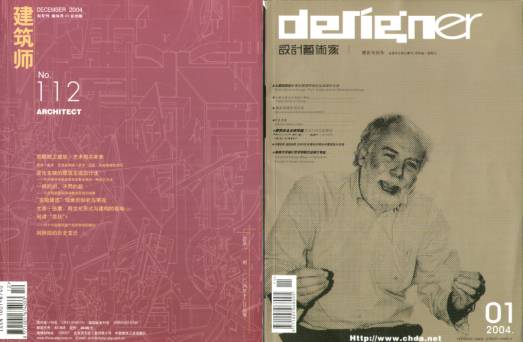
Covers of two Chinese magazines,” Architect” and “Designer” where
the activities of the program are focused. In the “Designer” magazine the cover
has the photo of the coordinator of the program, Prof. Celestino Soddu, during
the interview.
III. Partnership
The individual work of each
Generative Design Labs is summarized in the following sub-sections,
respectively.
Politecnico
di Milano University, Generative Design Lab
Main Activities:
-
Realization of the Generative
Art Conference 2002 (11-12-13 December 2002)
-
Realization of the Generative
Art Exhibition at Milan Polytechnic University (9-14 December)
-
Realization of Generative
Performance Festival at Aula Magna of Milan Polytechnic the 12th and 13th
December 2002.
-
Realization and publishing of
the book of proceedings of Generative Art Conference 2002. The book was printed
in time for the conference.
-
Participation to
institutional meetings concerning Italy-China exchanges.
-
Preparing and managing the
meeting of Asia-Link partners in Milan Polytechnic University the 10th December
2002.
-
Presenting papers (C.Soddu
and E.Colabella) at Generative Art Conference 2002
-
3 Thesis on generative design
presented for discussion at School of Architecture, Politecnico di Milano. These
thesis, with other around 120 thesis on generative design was published in the
website of the GDLab, www.generativedesign.com
for enhancing discussion between Asia-link program partners.
-
Expansion of Generative
Design Lab operational structure with new PC and new people.
-
Presentation of the advanced
searches of the laboratory to the Conference "International Nonlinear
Sciences Conference" to Vienna, with the contribution of C. Soddu and
E.Colabella, of the Generative Design Lab.
-
Presentation of the advanced
researches of the Generative Design Lab in other universities in Europe and in
the world, for example at Cities Asia Summit in Singapore, at ISEA, Nagoya
Japan, at Macau Cultural Center, at UCLA, University of California, Los
Angeles, at Alexandria Architecture Center, at IBD Center, Washington DC, at
Ball State University, at Pacific Design Center in California.
-
Realization of three
exhibitions of generative design at:
A. IDB Cultural Center, Washington DC
B. Pacific Design Center, Los Angeles
C. University Catholic of Peru, Lima
These exhibitions, with also studies on Chinese and Japanese cities and
their advanced possibilities to manage increasing complexity and identity, was
active until the end of April, and they will subsequently be moved to other
sites, like Macao, Shanghai, Tianjin and in Europe
-
Implementation of the website
of the program, showing all the activities of every partner.
-
Search of possible
operational developments of the program:
A. Meeting with possible Italian partners for activity
and projects of mutual interest in China
B. Possibility to spread in China some scientific
magazine of the involved fields.
C. Search of European interlocutors for the realization
of experimental generative architectures in China
-
Planning and preparation of a
series of lecture and workshop of Celestino Soddu and Enrica Colabella in
Shanghai and Tianjin for May-June 2002 (this activity was postponed to
September 2003 for the sanitary problems in the area)
-
Preparation of the seminar in
Milan for the end of July 2002, as defined in the program. (The seminar was
postponed to 29 November 2003 for Sars sanitary emergence)
-
Preparation of a seminar in
Macau for September 2002 on Generative Design approach and urban identity
management with the proposal to establish a PhD Master for Asian postgraduates
Architects and Engineers. (The Master, named Master IDEAS, Identity and Dynamic
Evolutions of Artificial Systems, was established and it will start up in September
2005 with the support of Macau government entities, University of Macau and
Politecnico di Milano University, with the direction of the coordinator of this
program, Prof. Celestino Soddu)
-
Call for paper of the
Generative Art Conference 2003 (April 2003 for the conference of10-12 December
2003)
-
Planning and organizing the
incoming GA2003 and its site www.generativeart.com
-
Implementation of the website
of The Asia-link programme
-
Preparation of the business
plan of the generative opportunities in China with mutual interest Europe-China
-
Planning a 2nd
level master in Macau for postgraduate Chinese architects and engineers,
concerning generative approach in town identity.
-
Preparing and managing the
incoming meetings of Asia-Link partners in Shanghai/Tianjin in September 2003
-
Managing the incoming
Workshops in Shanghai and Tianjin in September 2003.
-
Planning the new date (Nov.
2003) for the Chinese postgraduate seminars in Europe.
-
Implementation of Seminars, meetings
and workshops in China, Shanghai and Tianjin in September 2003.
-
Implementation of GA2003,
generative Art International conference, exhibition and performances.
-
Implementation of winter
course in Milan, November-December 2003, with inside two workshops, one managed
by GDLab of Kassel and the other by GDLab of Milan with the participation of
all partners.
-
Student Competition for
European and Asian people.
-
Preparation seminar in
Beijing in April 2004
-
Exhibition of generative
projects, also made for China inside the program at the University of Rome La
Sapienza
-
Lectures in China (Xi’an,
Changsha, Beijing, Shanghai)
-
The coordinator Prof. C.
Soddu is Honorary Professor of Xi’an University
-
Implementation seminar and
full workshop in Beijing at Italian Embassy with all partners and invited
guests from other Chinese universities.
-
Meeting for activity 6 at
Beijing and at Shanghai with Tongji University (April 2004)
-
Exhibition in Hong Kong of
generative projects at International Finance Centre (June 2004)
-
Meetings in Shengsen for
activity 6
-
Meeting in Macau for linking
with other Asia-link programs
-
Preparation of lectures and
workshops in China
-
Lectures and workshops in
China (October 2004)
-
Meetings in Beijing, Shanghai
and Wuxi for communication (activity 8) and implementation of activity 6
(November 2004)
-
Preparation of international
conference GA2004
-
Implementation of GA2004
(December 2004
Members of Generative Design Lab,
Politecnico di Milano University:
Prof. Celestino Soddu,
coordinator of the program
Prof. Quinsan Ciao,
co-coordinator of Chinese partners
Prof. Enrica Colabella,
manager
Eng. Giovanni Luca Soddu,
manager
Arch. Marco Longatti,
collaborator
Daniele Gugelmo, intern
Viviana Basilico, intern
The group of post graduate
students, as shown before.
Generative
Design Lab Kassel University
Main activities:
-
Participation, with
papers and round tables, to the GA2002, 5th International conference
on Generative Art
-
Participation to the 1st
meeting of all Asia-link partners in Milan.
-
Establishment of the
Generative Design Lab Kassel. The Generative Design Lab has been
implemented as a part of the “Institut für Rechnergestütztes Darstellen und
Entwerfen” at the School of Art, Kassel. Room Nr 77 in the atrium complex of
the School of Art has been allocated for the project. The acquisition of lab computer equipment as specified in the
project contract has been completed. In addition to the founds of the project
for equipment resources the School of Art Kassel has supported the Asia Link
Project with an additional Workstation including some software. The equipment
is installed and operable. The Internet connection was established at the end
of April 2003.
-
Research topics of the members in context of the
Asia Link Project:
1. Development
of Generative Software Prototypes for Different Fields of Application in
Architecture and Industrial Design
2. Theories and
Methods of Evolutionary Design
3. Teaching
Methods for Generative Design
4. Generative
Art Projects
5. Information
Systems / Programming
-
Research Activities. Current
Research Regarding the Activities of Team Members in Kassel
“Logo”. A
program generating variations out of a finite set of combinations.
“Loftgenerator”.
A generative program for applied industrial design.
“Uhrmacher”. A generative program using
combinatorial techniques.
“Liegengenerator.”
A generative program for mass customization of foldable furniture.
Search for
manufactures of the furniture generated by the program has started.
(Applied
Generative Procedures in Furniture Design. Proceedings of the 5th International
Conference GA 2002.)
“Next
Generation(s) Computer Aided Design - Next Generation Computer Aided Design
Education?" Paper submitted to ICSID 2nd Educational Conference 2003
Hanover, pending.
-
Research in Combination with teaching
activities.
Seminar
“Generative Prozesse und Verfahren” (Generative Processes and Procedures). This
seminar was the third one related to different subjects of Generative Design at
the Department of Product Design of the School of Art Kassel.
“Construction
of Design Spaces”. Graduate Research Project. To be completed in early October.
Preparation
of the first Asia Link Joint Workshop in Kassel. Up coming in July.
-
Exhibition Activities
Preparation
of a contribution to Sigraph 2003.
Will be
published in the conference proceedings of Sigraph 2003, art catalogue, p. 41,
42.
“Digital
Clouds”. Exhibition of Generative Art Work. Inauguration: Early summer
(schedule not fixed yet) at “Galerie Sommerfeld”, Erlangen, Germany.
“Rundgang
2003”. Presentation of selected student work from the Generative Design
seminar. Up coming July.
-
Operative Projects:
Collecting
and preparing material for a common web portfolio presenting in an overview
different works of Generative Design and Generative Art. An example of a web
portfolio, concerning some of the above mentioned research projects of the
Generative Design Lab Kassel were published in the common platform of the Asia
Link Project.
Establishing
connections to firms with Computer Numeric Controlled Manufacturing facilities
(First contacts have already been established in Kassel). Developing designs in
the field of Interior Architecture using generative approaches and testing
prototypical production with firms.
-
Proposal to use the Ming Paradigm of Design as a
design starting point for the generation of contemporary furniture and other
contemporary design objects.
-
Research and analyze typical patterns in Chinese
and European tradition. Based on the extraction and isolation of archetypes,
generative programs will be implemented as “pattern – generators”. The patterns
derived from Chinese sources will be restructured to fit the European market
and vice versa, the patterns of European origin will be restructured to fit the
Chinese market.
-
Analysis of typical elements of Chinese and
European “formal languages” as displayed by specific ranges of products (e.g.:
kitchen, bathroom). Identification of basic formal building blocks and
characteristics. Development of Generators (programs), which allow a mix of
elements
-
Active participation of
Seminars, meetings and workshops in China. (September 2003)
-
Participation to winter
course in Milan also with a workshop managed by GDLab of Kassel.
-
Participation to GA 2003 with
papers and round table.
-
Preparation seminar in
Beijing
-
Participation to seminar and
workshop in Beijing with reports and proposals. (April 2004)
-
Meeting for activity 6 in
Beijing
-
Meeting in Macau for linking
with other Asia-link programs
-
Common research works and
thesis common supervision (May-June-July 2004)
-
Preparation of international
conference GA2004
-
Common research works and
thesis common supervision (October November 2004)
-
Participation to meetings and
workshop for evaluating master thesis reports.
-
Participation to GA2004 with
proposals and papers.
Members of the Generative
Design Lab Kassel
Univ. Prof Hans Dehlinger (PhD)
Dipl.Des. Markus Schein (PhD cand.)
Dipl.Des. Oliver Endemann
Dipl.Des cand. Ole Werner
Guenther Doerner
Generative Design Lab of Eindhoven University of
Technology
Main Activities:
-
Participation to the 1st
meeting in Milan
-
Establishment of Generatrive
Design Lab
-
> GD system acquiring a
Pentium IV desktop computer
-
Identification of master and
doctorate candidate to involve in the program.
-
Establishment of Members of the Generative Design Lab Eindhoven: Prof.Dr.ir. Bauke de Vries, Chair of the
Design Systems group of the Faculty of Building and Architecture at Eindhoven
University of Technology. Research
expertise: Computer Aided Architectural Design, Product and Process Modeling,
Design information storage and retrieval, VR technology and Interfaces, CAD
tools and Sketch tools, Geometric modeling in Architectural Design, Knowledge
Based Systems Educational activities: CAAD and Design Methodology course for
first years students, Capita Selecta course for graduate students, ICT module
in the Post Doctoral programme on Architectural Design Management Systems.
Management activities: Chair of the Design Systems group, Management of
the research on the Design and Decision Support Systems. Author of more than 30
publications that have been presented on international conferences. Member of
13 PhD committees. Project task leader in Brite Euram project. Vice chair of
CAAD Futures foundation. Ing Aant van der Zee, Assistant Professor in the
Design Systems group of the Faculty of Building and Architecture at Eindhoven
University of Technology.
-
Seminars, meetings and
workshops in China and Europe.
-
Participation to winter
course in Milan 2003
-
Participation to Ga 2003 with
proposals and papers made by GDLab of Eindhoven
-
Established and implemented
common research works and thesis common supervision with Chinese partners and
with European too.
-
Participation to workshops
together with partners (February 2004)
-
Participation to summer
course in Rome with papers for the seminar “De Identitate” and proposals of
common design project for the subsequent workshop.
-
Preparation of international
conference GA2004
-
Common research works and
thesis common supervision (October November 2004)
-
Participation to meetings and
workshop for evaluating master thesis reports in Milan (December 2004).
-
Participation to GA2004
international conference with papers and discussion.
Generative Design Lab of
Tongji University
Main Activities
-
Participation of 3
professors, with papers and round tables, to the GA2002, 5th International
conference on Generative Art
-
Participation to the 1st
meeting of all Asia-link partners in Milan.
-
Activity
1: Establishing Generative Design Lab January/March
2003. In
Tongji University, the Generative Design Research Lab was established with the
basis of existing Chinese National Laboratory of Modern Technology in Urban
Panning and Design affiliated to and administrated by the College of
Architecture and Urban Planning of Tongji University, under the leadership of
Dean Bo-Wei Wang (Liaison/coordinator of this partner). The main research
objective of the National lab is the application of modern information
technology (IT) in urban planning and architectural design. The lab is well
equipped with modern IT technologies and devices, including computer networks,
SGI workstations, Virtual Reality experiment platform, and high precision
digital image and video stream encoding system, etc. In order to better support
the Generative Design research, additional equipment has been purchased for the
Lab, including the latest Pentium IV desktop computer.
-
Activity 5: Ph.D. and Master
Research Programs. The generative design research programs in the College of
Architecture and Urban Planning of Tongji University consist of a
multidisciplinary team. The participating disciplines include: campus planning,
urban design, historical architecture preservation, urban housing, interior
design, Chinese traditional furniture design, and computer system simulation.
The program team was established in the following six
groups:
-
Group1, led by Professor
Bo-Wei Wang, and joint by Master candidates Xiang Wang, Hong Wu, Le-Yan Zhang,
worked on the inherited generation mechanisms of university campuses and
similar type of architectural complexes;
-
Group 2, Master candidate
Meng Wang, guided by the advisor Professor Ji-wei Lu, worked on the inherited
generation mechanisms of urban public spaces;
-
Group 3, Ph.D. candidates
Yi-Jie Zhang and Ming Dai joint by Master candidate Cheng-yu Sun, under the
guidance of Professor Yong-yi Lu, worked on the inherited generation mechanisms
in Chinese historical architecture preservation;
-
Group 4, Master candidate
Xing-Yu Yang, guided by the advisor Associate Professor Zhen-yu Li, worked on
the inherited generation mechanisms of various urban housing;
-
Group 5, Master candidate Xi
Xu and Zhao-Xi Liu, guided by their advisors Associate Professor Yi Chen and
Lecturer Kai-fend Wang, worked on the inherited generation mechanisms of
Chinese traditional and ancient furniture design;
-
Group 6, Ph.D. candidate Xiao-Sheng
Huang and Master candidate Yao-dong Zhang, guided by their advisors Professor
Jing-Wen Gu and Lecturer Jie Wu, made a research of computer implementation of
shape and body representation governed by various generation mechanisms.
Among the six groups, Senior Engineer Mr. Zhong Tang,
Associate Director of the Lab, was the responsible for the coordination of the
groups in the project. Besides research in the generation mechanisms of Chinese
ancient towers, he experimented with the 3-D digital representation of
generated objects using virtual reality techniques.
Mr. Xiang Wang, a member of the Group 1, was also responsible for
information assembling and distributing of the whole project at Tongji
University.
-
Activity
4: Workshop. The College of Architecture
and Urban Planning of Tongji University has planned to host a generative design
workshop session in Shanghai September 2003. The proposed design topic of the
workshop is the Architectural Design for The International Expo 2010 to be held
in Shanghai.
-
Activity 8: International
Networking. The Tongji University team sent a delegation to Europe for research
information and notes exchange with European participating partners and larger
communities in the time frame of July to August. The delegation consists of a
part of the research participants of Tongji University who has achieved certain
preliminary results in their corresponding area of work. (2003 and 2004)
-
Activity 1: Generative Design
Lab. The Lab worked with 6 different research groups in the field of urban
design, historical architecture preservation, urban housing, interior design,
Chinese traditional furniture design. The experimentation in generative
approach are presented in the website of the program http://www.generativedesign.com/asialink/BoweiCV.htm,
in the website of the Shanghai Generative Design Lab and in the website of the
GA conferences www.generativeart.com.
-
Activity
4: Workshop. GDLab prepared the plan
workshop in September 2003. The proposed design topic of the workshop is the
Architectural Design for The International Expo 2010 to be held in Shanghai.
-
Activity 5: Ph.D. and Master
Research Programs. The generative design research programs activated are
implemented and are supported by European co-supervisors. Zhong Tang, Associate
Director of the Lab, designed the generation mechanisms of Chinese ancient
towers and 3-D digital representation of generated objects using virtual
reality techniques. In the meeting with Celestino Soddu, the 15th of
September, the research activity was verified and planned for the incoming
aims.
-
Implementation of Seminars,
meetings and workshops in Shanghai and Beijing in September 2003, April and
October 2004.
-
Participation to winter
course in Milan (December 2003)
-
Participation to Ga 2003 with
papers and research reports.
-
Preparation seminar in
Beijing in January-March 2004
-
Participation to seminar in
Beijing April 2004
-
Meeting for activity 6 in
Beijing and Shanghai (April 2004 and September-November 2004)
-
Implementation of common
research works and thesis common supervision
-
Preparation of international
conference GA2004 (October-November 2004)
-
Common valuation of research
works and Master thesis (Milan December 2004)
-
Presentation of papers to
GA2004 (December 2004)
The team of the Tongji GDLab:
Prof. Bowei Wang, responsible
of the team.
Senior Engineer Mr. Zhong
Tang, Associate Director of the Lab
Master candidates Xiang Wang,
Hong Wu, Le-Yan Zhang
Master candidate Meng Wang,
guided by the advisor Professor Ji-wei Lu
Ph.D. candidates Yi-Jie Zhang
and Ming Dai joint by Master candidate Cheng-yu Sun, under the guidance of
Professor Yong-yi Lu
Master candidate Xing-Yu
Yang, guided by the advisor Associate Professor Zhen-yu Li
Master candidate Xi Xu and
Zhao-Xi Liu, guided by their advisors Associate Professor Yi Chen and Lecturer
Kai-fend Wang
Ph.D. candidate Xiao-Sheng Huang and Master candidate Yao-dong Zhang, guided by their advisors Professor Jing-Wen Gu and Lecturer Jie Wu
Master candidate Wu Hong,
Wang Yi Sui and Zhang Le Yan guided by Prof. Wang Bo Wei
Doctorate Candidate Dai Ming.
Generative Design Lab of
Tianjin University
Main Activities
-
Participation, with
papers and round tables, to the GA2002, 5th International conference
on Generative Art
-
Participation to the 1st
meeting of all Asia-link partners in Milan.
-
Activity 1: Establishing Generative Design Lab (January/March 2003) The Generative Design Lab in Tianjin University was established based
in the existing Architectural Design and Planning Research Institute of Tianjin
University headed by the director Professor Chang-Ming Yang. Leveraging the
existing institute ad researchers’ previous research interests and strength,
the Generative Design Lab of Tianjin University, as one of the Chinese partner
universities, had one of its unique research directions set to the application
of generative design concept and theory into the investigation and comparative
study of archetypes and architectures of Chinese minority ethnic groups. In
order to sustain the Generative Design Lab and relevant research activities,
the Architectural Design and Planning Research Institute of Tianjin University
applied for addition funding from Chinese government through programs of
Ministry of Education.
-
Activity 5: Ph.D.
and Master Research Programs. The
first Ph.D. and Master level graduate research program in generative design at
Tianjin University was focused on the general topic of “The
Generative Mechanism of Chinese Nomads Architecture and Its Interpretation in
Cultural Anthropology”. The research program has identified a combined
participating team of five members of faculty and research staff, and,
initially, six postgraduate students, later enlarged to other 7 people. As one of the first individual Ph.D. research
topic, Mr. Li Yan has identified the subject of “The Research of Contemporary Architectural
Generative Rule” and made his investigation under the guidance of his advisor
Prof. Chang-Ming Yang. His dissertation was completed in 2004. All the thesis
of involved postgraduates was completed with shared supervisions of European
Professors.
-
Activity 4:
Workshop. The Tianjin University
partner hosted the workshop in Tianjin.
-
Activity 6. During
the first meeting in Tianjin with the coordinator and other partners, GDLab of
Tianjin has proposed some design occasion. Defined two real projects to be developed by European and Chine GDLabs
together:
- Reconstruction of Haihe
Lou (a traditional Chinese style multi-storied building near the Haihe
River in Tianjin which was a famous scene and a temporary palace of the
emperors in the Qing Dynasty)
- Reversion of Austro-Hungary
Consulate in Tianjin, which is confirmed recently. The Lab worked to
define rules and organization to effort these opportunities.
-
A proposal of a
New Town was received by the Government and discussed with the Coordinator of
the program, Prof. Celestino Soddu. A first visit to the involved environment
was made together with government officers, Prof. Soddu and Prof. Dehlinger and
a first schedule of the town design project was defined. In the
second year of the program these occasions were discussed and effort together
with the other partners and the projects were presented to the city
administration for the realization.
-
Activity 8: International Networking. The Tianjin University partner expanded its
international networking in the area of Generative Design through this project
and its European partners. The Tianjin University’s project participating team
visited European university with a representative delegation while attending
the Summer Courses, enlarging their time in Europe.
-
Activity 1 in 2004: Generative Design Lab. The Generative Design
Lab in Tianjin University worked particularly in the field of generative
architecture design. The experimentation in generative design approach were
presented in the website of the programme
http://www.generativedesign.com/asialink/GA-TJU.htm .
-
Activity
4: Workshop. GDLab hosted and
implemented the planned workshop in September 2003 with a study case in
Tianjin.
-
Activity
5: Ph.D. and Master Research
Programs. The Ph.D. and Master level graduate research program in generative
design at Tianjin University “The
Generative Mechanism of Chinese Nomads Architecture and Its Interpretation in
Cultural Anthropology”. Mr. Li Yan implemented his programme “The Research of Contemporary Architectural Generative
Rule” referring to common supervisions.
-
Activity 6. Applied projects.
Defined two real projects to be developed by European and Chine GDLabs
together:
- Reconstruction of Haihe
Lou (a traditional Chinese style multi-storied building near the Haihe
River in Tianjin which was a famous scene and a temporary palace of the
emperors in the Qing Dynasty)
- Reversion of Austro-Hungary
Consulate in Tianjin, which is confirmed recently. The Lab worked to
define rules and organization to effort these opportunities.
- A proposal of a New Town was
received by the Government and discussed with the Coordinator of the
program, Prof. Celestino Soddu. A first visit to the involved environment
was made together with government officers, Prof. Soddu and Prof.
Dehlinger and a first schedule of the town design project was defined.
-
Participation to winter
course in Milan with professors and postgraduate students. Participation to the
competition “Idea as code”.
-
Participation to Ga 2003 with
papers, proposals and discussion concerning master and doctorate thesis.
-
Preparation seminar/workshop
in Beijing implementing the documentation of some case study to use inside
activity 6 too.
-
Meetings for activity 6 (two
times each year)
-
Common research works and
thesis common supervision
-
Participation to workshop and
valuation of thesis and research results in December 2004 in Milan
-
Preparation and participation
to international conference GA2004 with papers and round table.
The team of this lab was:
Prof. Changming Yang,
responsible of the team
Prof. Yukun Zhang,
Architecture
Prof. Wei Zhang, Architecture
Prof. Wei Wang, Architecture
Prof. Hua Zhang, Staff Researcher,
Architecture
Prof. Fan-Wei Zhang, Staff
Researcher, Architecture
Prof. Jie Cai, Associate
Professor, Architecture
Jun Ren, Lecturer,
Architecture
Xi-Xin Chen, Ph.D. candidate,
Architecture
Lin Tian, Ph.D. candidate,
Ancient Architecture Preservation
Jing Bai, Ph.D. candidate,
Architecture
Li-Jun Zheng, Ph.D.
candidate, Architecture
Jin-Song Zhao, Ph.D.
candidate, Architecture
Li Yan, Ph.D. candidate,
Architecture
Xiao-Bing Wang, Master
candidate, Architecture
Rong Lin, master candidate,
Architecture
IV. Links with other projects/programmes
1.
As described in the
activities, a parallel program was established: the Master I.D.E.A.S. with the
collaboration of Politecnico di Milano University and the University of Macau
involving all the partners of Asia-link program. This Master, a course of PhD
level directed by Prof. Celestino Soddu, the coordinator of this program, is
supported by Macau government funds and will start up next September 2005. It
has a strong synergy with Asia-link program because it has: The same aims:
Generative design and advanced design approach, Cultural and professional
exchange between Europe and China, Upgrade of post graduated people.
2.
Visit to European
Universities (Rome and Milan) of delegates for tourist activities of the main
cities in China, organized by the Milan GDLab and IEEMacau.
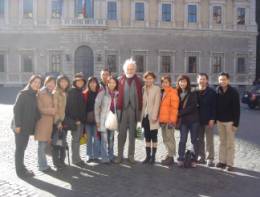
V. Assessment of the project
The only difficulty
encountered was the sanitary emergence in China from March to July 2002. The
travel of the coordinator to Shanghai and Tianjin, and the subsequent meetings
and lectures planned for the beginning of May, was postponed and re-scheduled.
After the end of this sanitary emergence the program went on well and all the
planned activities were implemented. All the activities postponed because of Sars
were implemented in the subsequent months. The planned summer courses and
workshops in starting from September 2003 were held in the planned period.
Ø
The initial impact was the difficulty but also the interest about the
involvement of all partners in this advanced design approach
Ø
The expected results were easily achieved in some activities, like the
establishment of the Generative Design Labs, research exchange and teaching. It
was more difficult in applied projects. The reason were difficulties regarding
Chinese approach to building construction and management and industrial
approach to design management. In the last year these difficulties were
approached with an enlarged panel of Chinese partners and some results were
reached. In the other activities, like 7 and 8 concerning international
exchange and communication, the results are over the expected because of the
full participation of the Chinese teams to the planned international events
with interesting papers born from the program activities and the really
positive output of Chinese magazines in the field of architecture and design
concerning the design approach proposed by the program.
Ø
The assumption made in the
logical framework was
revealed true. Details are explained in the upgraded logical framework,
attached to this report.
Ø
The areas involved, town
design, architecture and industrial production, especially regarding applied
projects (the 6th activity) had differences: the most potential area
is town design, then industrial design and architecture. Town design was
important because of the loss of identity of Chinese cities, owned to the fast
development of urban systems, is a real problem and emergence in China.
Regarding industrial design and architecture, we needed to produce a business
research to identify reasons and opportunities to enhance our program and we
used it for going ahead. The results were reached and they are interesting for
the sustainability of the program after the end of EC financial support.
Ø
What Lessons. The program had a progressive increase of the
activities in the second year.
Identifying positive and negative lessons, we can fix some points: 1st,
positive, the European approach to design is a real opportunity for exchanging
European-Chinese cultures because some potentialities of this design approach,
and subsequentially of the program emerged as able to fit needs and solve
problems linked to the fast grow of Chinese cities. 2nd, negative,
the European approach to cities management and industrial production could be
stopped by rules and burocracy of China, sometimes reducing the possibility to
work together in a common design team.
3rd, positive, identifying common research fields, like
cities identity, and going ahead with mutual knowledge of teaching and research
approaches it’s possible to establish channels to collaboration also in field,
like design common teams, that, in the first moments, appeared like really
complicated.
Ø
It was possible, following
common experiences implemented in the program, to reach the sustainability of
the program through common design activities involving Europeans and Chinese
people in the field of the generative design. This particularly with the
Chinese partner Tianjin University regarding Architectural projects. With
Tongji partner the sustainability of the program is only in the research and
academic activities, witch is going ahead with agreement for exchanging people
and for collaborations in research programs
VI. Impact and Sustainability
The impact of the program has
overcome the forecasts. This because of the topic, linked to some really
important questions for contemporary age in China: the creativity-design
relationship, the use of tradition in advanced generative design and the
identity as quality of cities and products.
It’s possible to verify this
important impact:
2.
The teaching activity of
involved Chinese university has changed and the proposed generative approach is
considered and used as advanced approach to design.
3.
The GDLabs continued their
activity in research and they are linked to European universities.
4.
Other Chinese universities,
like Tsinghua, Hunan, Xi’an and Shanghai University asked to be involved in the
program and asked to design a new program focusing the topics of Identity and
advanced design approach.
5.
The feedbacks of Chinese
magazines focused on Architecture and design was impressing, also valuating the
short time from the realization of the program
6.
The Chinese Embassy and
Consulate in Italy, with their attention to the program and to the development
of its activities signed an important feedback confirming the success of the
program.
VII. Recommendations
7.
special
recommendations concerning the project’s future
a.
Supporting,
with bilateral or multilateral agreements the possibility to continue the
mutual knowledge and collaboration process established by the program. Some
bilateral agreements were already done.
b.
Establishment
of a master program able to involve, in the next year European and Chinese
postgraduates in a common view of important questions concerning town identity
and town quality. This topic, “Identity, design and tradition” is essential for
the contemporary fast development of Asian countries and if the most important
topic regarding architecture and town design for Chinese people.
8.
general
recommendations
a.
Following
the requests of other Chinese universities to participate to the project, a new
project involving other universities and focused on Cultural identity and
Cities identity could be a good opportunity to fix the channel opened by this
program and establish an important mutual collaboration between Europe and
China in this interesting field of culture but also of business.
b.
The
possibility to open to other Asian countries could be an interesting
possibility too.
9.
information
for ex-post evaluation
a.
contact
and more news about the coordinator of the program:
http://www.generativedesign.com
tel. (+39) 02.2399.5418
(+39) 02.2399.5483
(+39) 02.2399.5401 segretery
fax (+39) 02.2399.5454
mobile: (+39) 335.6099787
b.
managers
of the program:
Quinsan Ciao qciao@aol.com
Enrica Colabella enrica.colabella@polimi.it
c.
all
contacts of partners are in this document and in the website www.generativedesign.com/asialink/asialink.htm
Kassel:
Hans Dehlinger dehling@uni-kassel.de
Ole Werner ole_Werner@web.de
Eindhoven:
Bauke de Vries b.d.vries@bwk.tue.nl
Daans Willems d3vlin@hotmail.com
Tongji Univ.:
Wang Bowei wangbw@public1.sta.net.cn
Zhang Kun doctorkun@hotmail.com
Tianjin Univ:
Chang Ming Yang 27407575@163.com
Zhang Wei zhangwei@tju.edu.cn
d.
Alessandro
Balducci, the director of DIAP department at Politecnico di Milano University
were the coordinator of the program works:
tel. (+39) 02.2399.5401
Fax (+39) 02.2399.5435
Giancarlo Spinelli, deputy of the Rector of Politecnico di Milano
University for international activities:
VIII.Annexes
Ø
Proceedings
of seminar “De Identitate” in Rome July 2004
Ø
Proceedings
of GA2002 international conference
Ø
Proceedings
of GA2003 international conference (also with paper about report of EU-China
business perspectives)
Ø
Proceedings
of GA2004 international conference
Ø
Main
Articles in Chinese magazines
Ø
CD
with Asia-link program 10 website
Ø
Video
of seminar – workshop “Identity&Design” in Beijing April 2004
Ø
Video
of workshop in Milan 2003
Ø
Logical Framework with final
valuations
Ø Action Plan
Ø Schedule of Activities
Ø
Financial Report
Ø
Notes to Financial report
Ø
Audit
Ø
Final Payment Request
The Coordinator of the
Asia-Link program n.10
Prof. Celestino Soddu
The Director of DIAP
Department of Politecnico di Milano University
Prof. Alessandro Balducci
The Deputy of the Rector of
Politecnico di Milano for international relations and researches
Prof. Giancarlo Spinelli